
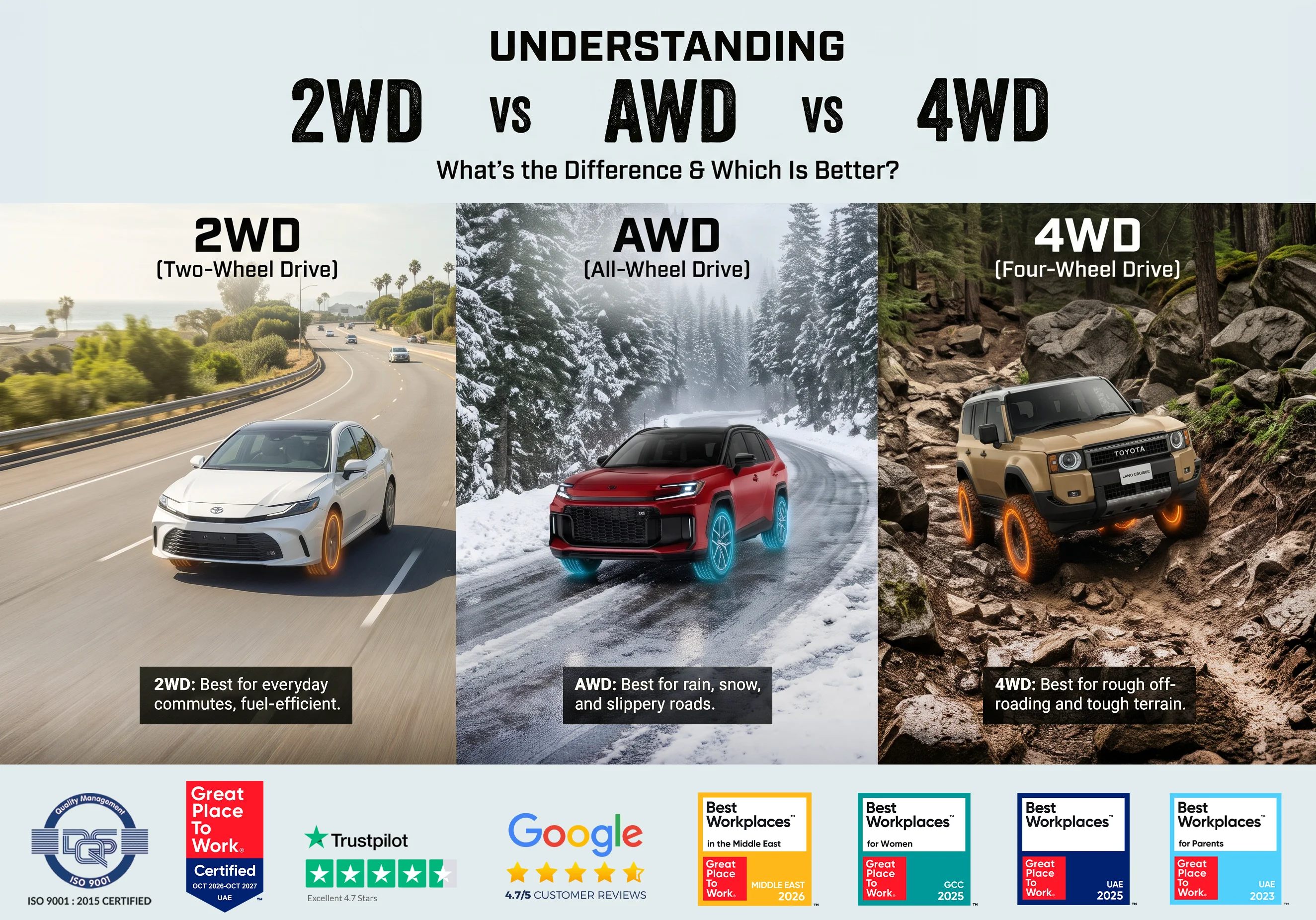
UNDERSTANDING 4WD VS 2WD VS AWD: WHAT'S THE DIFFERENCE AND WHICH IS BETTER?
Choosing the right drivetrain is an important part of buying a vehicle. Whether you are looking for a pickup truck, SUV or passenger car, understanding the differences between 4WD, 2WD and AWD can help you make the right decision. Each drivetrain offers different advantages in terms of traction, handling, fuel efficiency and driving performance. At Sahara Motors, Dubai, UAE, we offer a wide selection of new vehicles, including 4WD SUVs, 2WD pickups and AWD vehicles for international buyers. Let's explore how these drivetrain systems work and which one is best for your driving requirements.
What Is 2WD (Two-Wheel Drive)?
Two-Wheel Drive (2WD) is a drivetrain system that delivers engine power to only two wheels. Depending on the vehicle design, power is transferred to either the front wheels or rear wheels. This system is commonly found in passenger cars, sedans and pickup trucks. 2WD vehicles are generally suitable for everyday transportation, city driving and highway journeys. Since they have a simpler drivetrain configuration, they can offer better fuel efficiency and lower maintenance costs compared to many 4WD and AWD vehicles.
Advantages of 2WD:
- Generally better fuel efficiency.
- Lower drivetrain complexity.
- Suitable for city and highway driving.
- Often more affordable to purchase and maintain.
- Practical for everyday transportation and commercial use.
What Is 4WD (Four-Wheel Drive)?
Four-Wheel Drive (4WD), also known as 4x4, is a drivetrain system designed to deliver engine power to all four wheels. It is commonly available in off-road SUVs and pickup trucks. Many 4WD vehicles feature selectable driving modes that allow drivers to engage four-wheel drive when additional traction is required.
This drivetrain is particularly useful for challenging environments such as deserts, muddy roads, rocky surfaces and uneven terrain. Some 4WD systems also feature low-range gearing, which provides additional control when driving through demanding off-road conditions.
Advantages of 4WD:
- Improved traction on challenging surfaces.
- Suitable for desert and off-road driving.
- Better capability on sand, mud and rocky terrain.
- Available with high-range and low-range driving modes on many models.
- Ideal for adventure SUVs and capable pickup trucks.
What Is AWD (All-Wheel Drive)?
All-Wheel Drive (AWD) is a drivetrain system that distributes engine power to all four wheels, either continuously or automatically when additional traction is needed. Many modern AWD systems adjust power distribution between the front and rear wheels depending on driving conditions. Unlike traditional selectable 4WD systems, most AWD systems operate automatically without requiring the driver to manually engage four-wheel drive. This makes AWD a convenient option for everyday driving, particularly on wet roads, slippery surfaces and changing road conditions.
Advantages of AWD:
- Automatic power distribution in many systems.
- Improved traction on slippery roads.
- Enhanced driving confidence in changing conditions.
- Suitable for everyday and long-distance driving.
- Commonly available in modern SUVs and luxury vehicles.
4WD vs 2WD vs AWD: What Are the Main Differences?
Although all three drivetrain systems are designed to transfer engine power to the wheels, their operating methods and capabilities are different. 2WD powers only two wheels, making it a practical choice for regular road use and everyday transportation. In comparison, 4WD provides power to all four wheels when engaged and is designed for demanding off-road conditions. AWD also powers all four wheels, with many systems automatically adjusting power distribution to improve traction. Fuel consumption, maintenance requirements and driving performance depend on the vehicle model, engine, drivetrain design and driving conditions.
Which Drivetrain Is Best for Your Driving Needs?
Choosing between 4WD, 2WD and AWD depends on your driving environment, budget and intended vehicle use.
Choose 2WD if you mainly drive in cities and on highways. It is a practical option for everyday transportation, commercial applications and buyers who prioritise fuel efficiency and affordable ownership.
Choose 4WD if you frequently drive on sand, mud, rocky surfaces or challenging terrain. It is particularly suitable for off-road enthusiasts, desert driving and commercial activities that require additional traction.
Choose AWD if you want additional traction for everyday driving and regularly encounter wet or slippery roads. It is a convenient choice for families, SUV owners and drivers who prefer automatic power distribution.
Popular Toyota Vehicles with Different Drivetrain Options
Toyota offers a wide range of vehicles with different drivetrain configurations to suit various driving requirements.
The Toyota Land Cruiser 300 is a popular full-size SUV with 4WD capability, offering a combination of off-road performance and driving comfort. The Toyota Hilux is available in different configurations, including 2WD and 4WD, depending on the model and market. The Toyota RAV4 offers front-wheel-drive and AWD configurations in selected markets, while the Toyota Fortuner is available in 2WD and 4WD variants in selected markets.
These vehicles provide different options for customers looking for family SUVs, commercial pickups and off-road vehicles.
Final Thoughts: Which Is Better, 4WD, 2WD or AWD?
There is no single drivetrain that is best for every driver. 2WD is a practical choice for everyday transportation, 4WD is suitable for demanding off-road conditions, and AWD provides additional traction for changing road surfaces.
Before purchasing a vehicle, consider your driving environment, fuel consumption expectations, maintenance requirements and performance needs. Selecting the right drivetrain can help you enjoy better driving performance and long-term value.
At Sahara Motors, Dubai, UAE, we offer a diverse collection of new Toyota SUVs, pickup trucks, sedans and other vehicles for international export. Explore our vehicle collection and find the right model to match your requirements.
Contact Sahara Motors today to enquire about available vehicles and international export options.
Frequently Asked Questions (FAQs)
1. What is the main difference between 4WD, 2WD and AWD?
2WD delivers engine power to two wheels, while 4WD and AWD distribute power to all four wheels. 4WD is generally designed for challenging off-road conditions, whereas AWD is commonly used for everyday driving and improved traction on slippery roads.
2. Is 4WD better than AWD?
4WD is generally better for demanding off-road driving, including sand, mud and rocky terrain. AWD is more convenient for everyday driving and changing road conditions. The better option depends on your driving requirements.
3. Which drivetrain offers better fuel efficiency?
2WD vehicles generally offer better fuel efficiency because their drivetrain systems are less complex. However, actual fuel consumption depends on engine size, vehicle weight, transmission and driving conditions.
4. Is AWD suitable for off-road driving?
Some AWD vehicles can handle light off-road conditions, gravel roads and uneven surfaces. However, traditional 4WD vehicles with suitable ground clearance and low-range gearing are generally better for demanding off-road environments.
5. Is 2WD suitable for pickup trucks?
Yes. 2WD pickup trucks are suitable for everyday transportation, highway driving and many commercial applications. They are often a practical choice when extreme off-road capability is not required.
6. Which drivetrain is best for desert driving?
4WD is generally the preferred option for desert driving because it provides additional traction on loose sand. However, suitable tyres, tyre pressure, ground clearance and driver experience are also important.
7. Are Toyota Hilux models available in 2WD and 4WD?
Yes. Toyota Hilux models are available in different 2WD and 4WD configurations, depending on the model, engine and destination market.
8. Does AWD mean all four wheels receive equal power?
No. AWD systems do not necessarily distribute equal power to all four wheels. Power distribution varies depending on the drivetrain design and driving conditions.
9. Which drivetrain is best for everyday driving?
2WD is a practical option for regular city and highway driving. AWD can provide additional traction when road conditions change. Your choice should depend on your driving environment and preferences.
10. Can I buy 4WD and 2WD vehicles from Sahara Motors Dubai?
Yes. Sahara Motorsoffers a diverse selection of new vehicles, including Toyota SUVs, pickup trucks and other models with different drivetrain configurations for international export. Contact our team to enquire about available vehicles and specifications.