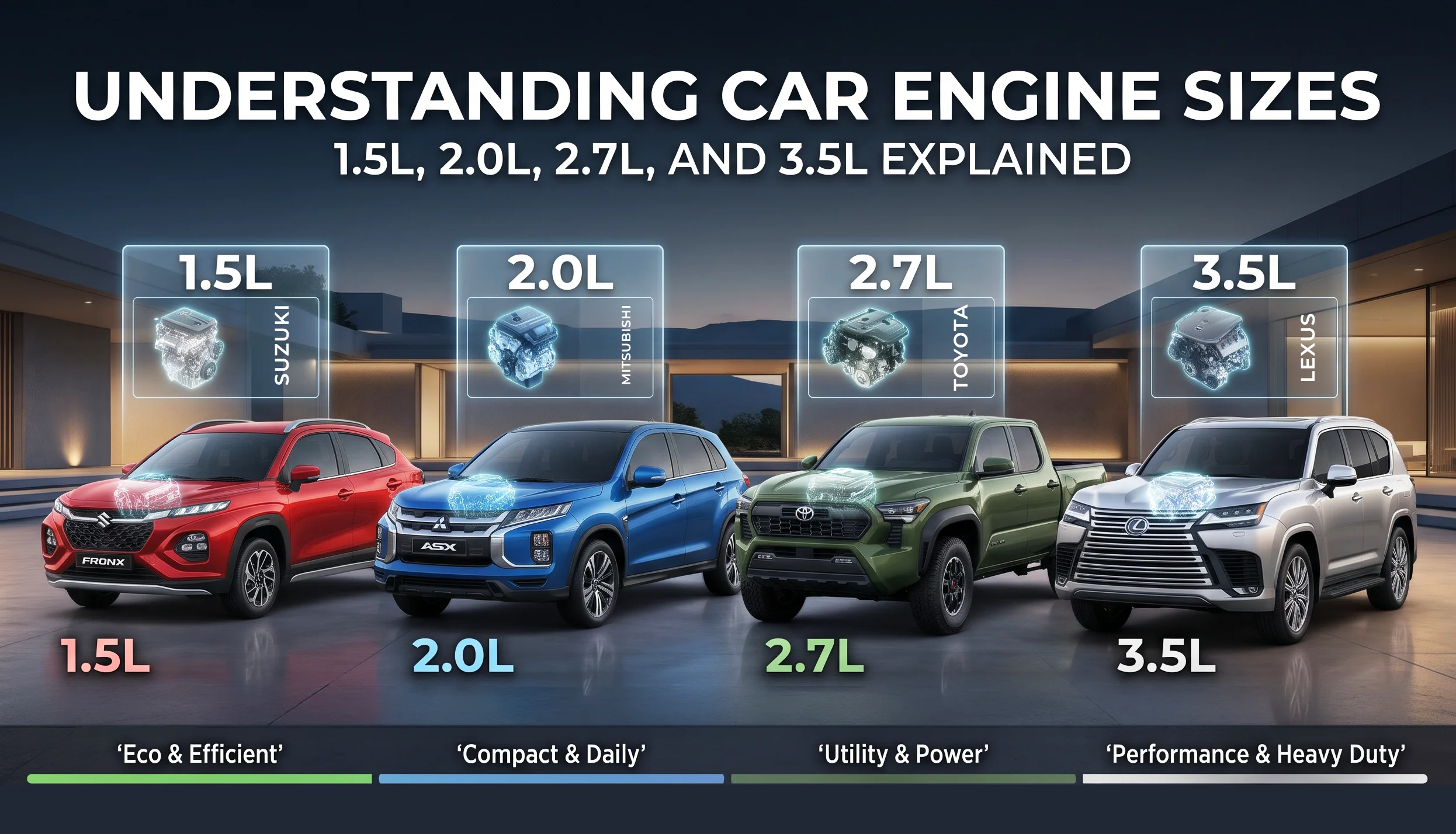
UNDERSTANDING CAR ENGINE SIZES: 1.5L, 2.0L, 2.7L AND 3.5L EXPLAINED
When buying a new car, one of the most important المواصفات to consider is engine size. Whether you are looking for a compact sedan, a family سيارات الدفع الرباعي, a powerful بيك اب truck, or a فاخرة vehicle, understanding engine capacity can help you make the right buying decision.
Engine sizes such as 1.5L, 2.0L, 2.7L and 3.5L are commonly found in modern vehicles. But what do these numbers actually mean? Does a bigger engine always deliver more power? Does a smaller engine automatically consume less fuel?
In this guide, we explain car engine sizes, their differences, performance characteristics, fuel consumption, and how to choose the right engine for your driving needs.
What Does Car Engine Size Mean?
Car engine size, also known as engine displacement or capacity, refers to the total volume swept by all the pistons inside an engine's cylinders during their movement. It is generally measured in litres (L) or cubic centimetres (cc).
For example:
- 1.5L = 1,500cc
- 2.0L = 2,000cc
- 2.7L = 2,700cc
- 3.5L = 3,500cc
Generally, a larger engine can burn more air and fuel per combustion cycle, potentially producing greater power and torque. However, engine performance also depends on other factors, including turbocharging, engine design, tuning, fuel type, transmission and vehicle weight.
A larger engine doesn't necessarily mean a faster car, and a smaller engine doesn't necessarily mean a less powerful one.
Understanding Different Engine Sizes
1.5L Engine – Fuel Efficiency and Everyday Driving
A 1.5L engine is commonly found in compact sedans, hatchbacks, smaller سيارات الدفع الرباعي and some hybrid vehicles. It is generally designed to provide a balance between everyday performance, fuel economy and affordable running costs.
These engines are suitable for daily commuting, city driving and regular journeys. Depending on the vehicle, a 1.5L engine may also use turbocharging or hybrid technology to improve performance.
Best suited for:
- Daily city driving
- Small families
- Commuting and regular travel
- Drivers prioritising fuel economy
A 1.5L engine can be an excellent choice for drivers who need a practical vehicle for everyday use without requiring excessive power.
2.0L Engine – Balanced Performance and Versatility
A 2.0Lengine is one of the most common engine sizes across modern vehicles. It is widely used in sedans, crossover سيارات الدفع الرباعي and larger passenger cars because it offers a practical balance between power, efficiency and drivability.
Compared with a smaller engine, a 2.0L engine may offer more comfortable acceleration, particularly when travelling on highways or carrying passengers. Depending on its design, it may be naturally aspirated, turbocharged or part of a hybrid powertrain.
Best suited for:
- Everyday driving and commuting
- Family sedans and crossover سيارات الدفع الرباعي
- Highway journeys
- Drivers seeking a balance of performance and economy
A 2.0L engine can be a versatile choice for buyers who need enough power for everyday driving without moving into larger engine categories.
2.7L Engine – More Capability for سيارات الدفع الرباعي and بيك اب Trucks
A 2.7L engine is commonly associated with mid-size سيارات الدفع الرباعي and بيك اب trucks, where additional power and torque can be beneficial. Depending on the engine configuration, it can provide stronger acceleration, better load-carrying capability and more comfortable performance in demanding driving conditions.
For buyers looking for a practical vehicle for work, family use or travel across different road conditions, a 2.7L engine can be an attractive option.
Best suited for:
- Mid-size سيارات الدفع الرباعي
- بيك اب trucks
- Business and utility applications
- Carrying passengers and equipment
- Drivers requiring additional performance
The actual capabilities of a 2.7L vehicle depend on its engine technology, drivetrain, torque output, gearing and vehicle weight.
3.5L Engine – Powerful Performance and Driving Comfort
A 3.5L engine is commonly found in larger سيارات الدفع الرباعي, بريميوم vehicles, بيك اب trucks and performance-oriented models. These engines are often designed to deliver stronger acceleration, higher power output and greater torque, making them suitable for larger and heavier vehicles.
Some 3.5L engines use V6 configurations, turbocharging or hybrid technology to enhance performance. They are particularly attractive to drivers who prioritise power, smooth highway driving, towing capability where permitted, and a more responsive driving experience.
Best suited for:
- Large سيارات الدفع الرباعي
- بريميوم and فاخرة vehicles
- Long-distance highway driving
- Drivers prioritising power and acceleration
- Applications requiring higher performance
While a 3.5L engine may offer impressive performance, it can also have higher fuel consumption and running costs, depending on the vehicle and how it is driven.
1.5L vs 2.0L vs 2.7L vs 3.5L Engine Comparison
Engine Size | Typical Application | Main Advantage |
1.5L | Compact cars, smaller سيارات الدفع الرباعي | Economy and daily practicality |
2.0L | Sedans, crossovers, family سيارات الدفع الرباعي | Balanced performance |
2.7L | سيارات الدفع الرباعي, بيك اب trucks | Capability and versatility |
3.5L | Large سيارات الدفع الرباعي, بريميوم vehicles | Strong performance and power |
These are general characteristics, not fixed rules. Engine output and fuel consumption vary considerably by model, technology, vehicle weight and drivetrain.
Does a Bigger Engine Always Consume More Fuel?
In many cases, larger engines consume more fuel because they can burn more air and fuel and may be fitted to heavier vehicles. However, engine size alone does not determine fuel consumption.
Fuel economy also depends on:
- Vehicle weight and aerodynamic design
- بنزين or ديزل engine technology
- Turbocharging and hybrid systems
- Transmission type
- Driving style and speed
- Traffic and road conditions
- Maintenance and tyre pressure
For example, a turbocharged 1.5L engine may deliver more power than an older naturally aspirated 2.0L engine. Similarly, a hybrid vehicle with a larger engine may achieve better fuel economy than a conventional vehicle with a smaller engine under certain driving conditions.
Therefore, when comparing vehicles, it's important to look at engine capacity alongside horsepower, torque and fuel economy figures rather than relying on engine size alone.
What Is the Difference Between Engine Capacity, Horsepower and Torque?
These three المواصفات are often confused, but each describes a different aspect of engine performance.
Specification | Meaning | Why It Matters |
Engine capacity (L/cc) | Volume swept by the pistons | Helps understand engine size |
Horsepower (HP) | Rate at which an engine performs work | Influences acceleration and speed capability |
Torque (Nm) | Rotational force produced by the engine | Helps with pulling, load movement and acceleration |
A vehicle with a smaller engine but turbocharging may produce more horsepower and torque than a larger naturally aspirated engine. This is why comparing the complete المواصفات is important before buying a vehicle.
Which Engine Size Should You Choose?
The best engine size depends on how you intend to use your vehicle.
- Choose 1.5L if your priority is everyday commuting, practical driving and potentially lower fuel consumption.
- Choose 2.0L if you want a balanced option for commuting, family use and highway travel.
- Choose 2.7L if you are considering a capable سيارات الدفع الرباعي or بيك اب for mixed usage, including carrying passengers or equipment.
- Choose 3.5L if you want stronger performance in a larger سيارات الدفع الرباعي or بريميوم vehicle and are comfortable with potentially higher fuel costs.
Before making a purchase, consider your budget, driving conditions, number of passengers, cargo requirements and expected fuel expenses.
Final Thoughts
Understanding car engine sizes makes it easier to compare vehicles and select one that meets your needs. A 1.5L engine can be an excellent choice for everyday efficiency, a 2.0L engine offers a versatile balance, a 2.7L engine can suit سيارات الدفع الرباعي and utility vehicles, while a 3.5L engine may provide the additional performance required for larger and more powerful vehicles.
Ultimately, the best engine isn't necessarily the biggest one. It is the engine that delivers the right balance of performance, fuel efficiency, practicality and long-term value for your driving needs.
At صحارى موتورز, دبي, explore a diverse range of new vehicles with different engine sizes, configurations and performance capabilities to find the right vehicle for your requirements.
Looking for your next vehicle? Explore our collection of new cars في صحارى موتورز, دبي.