
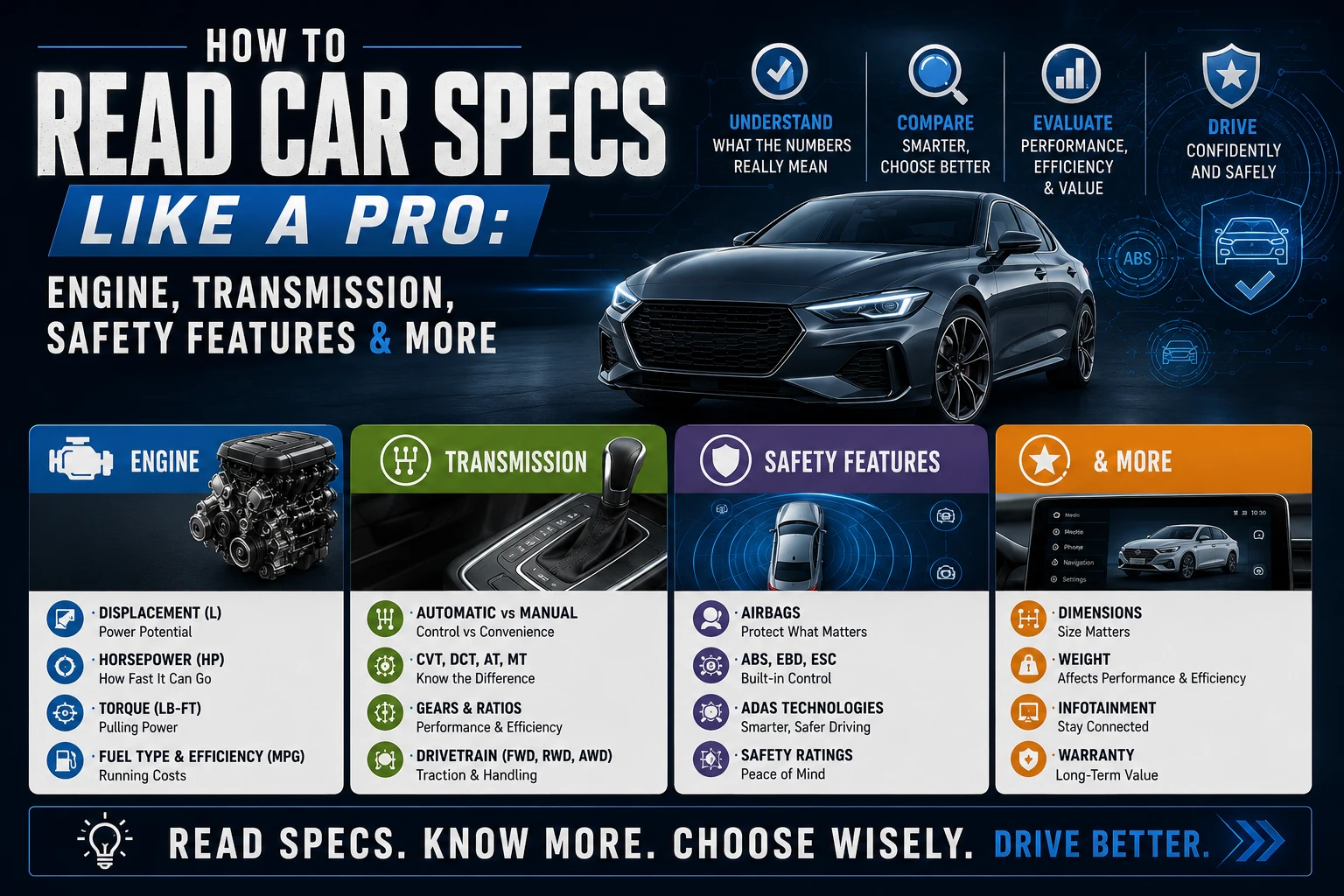
How to Read Car Specs Like a Pro: Engine, Transmission, Safety Features & More
Buying a brand-new car to export is exciting, but it can also be overwhelming—especially when you start seeing long lists of technical terms. For many buyers, car specifications look like “just numbers.” In reality, those numbers and labels are the real story of how a car will perform, how safe it will be, how comfortable it feels, and even whether it will be a reliable choice for the type of driving conditions in the destination country.
The good news is that you don’t need to be a mechanic to read car specs well. If you know what each spec category means and how it affects everyday driving, you can compare different cars confidently and choose the best match for your needs.
1) Start With the Basics: Model, Trim & Purpose
A smart place to begin is the basics: the model name and the trim level. The same model can come in different versions, and the trim often changes key items such as safety features, infotainment, seat design, camera systems, and the type of transmission. For example, a base trim might have the essential safety equipment, while a higher trim could add advanced driver-assistance features like automatic emergency braking or lane alerts. The body type also matters because it affects space and practicality. SUVs and crossovers may suit families and buyers who want higher ground clearance, while sedans can be more efficient and comfortable for long highway trips. When you’re exporting, thinking about where the car will be driven—city streets, highways, rough roads, rainy seasons—will help you read the rest of the specs correctly.
2) Engine Specs: What They Really Tell You
Next, focus on the engine details, because the engine largely determines the car’s driving character. You’ll typically see engine size, fuel type, and whether the engine is turbocharged. Engine size is often listed as something like 1.5L, 2.0L, or 2.4L, and while bigger doesn’t always mean better, it can give a general idea about power potential and driving feel. Fuel type is equally important. Petrol (gasoline) engines are common and may be easier to maintain in many places, while diesel engines are often preferred for long-distance driving and can be very efficient depending on the model. If you see hybrid options, those can be great for buyers who want fuel savings, especially in mixed driving environments. Turbo engines are another important label; they often provide stronger acceleration and efficiency compared to a non-turbo engine of the same size. However, how the turbo responds at low speeds can vary from model to model, so it’s worth paying attention to torque figures and how the car behaves in traffic.
3) Power & Torque: The “Feel” of the Car
Power and torque are two numbers you should learn to interpret. Power is commonly shown in horsepower (HP) or kilowatts (kW) and is a good indicator of overall strength. Torque, usually shown in Newton-meters (Nm), often matters more for real-life driving—especially when starting from a stop, climbing hills, or pulling smoothly through slow traffic. A car with strong torque can feel easier and more responsive, even if its horsepower figure isn’t the highest. In practical terms, torque helps a vehicle move confidently without needing to rev as much, which can make driving feel calmer and more efficient. When comparing two cars, don’t only chase the highest power rating—look at torque and how it pairs with the transmission, because the driving experience depends on the full system.
4) Transmission: Automatic vs Manual, and Why It Matters
After the engine, the transmission is the next major spec category to understand. Transmission type affects comfort, ease of driving, fuel use, and how smoothly the car responds when you accelerate. Automatic transmissions are popular because they make everyday driving simple, especially in traffic. Many export buyers prefer automatics for convenience, but it’s still important to check which type of automatic it is and how it’s described. CVT (continuously variable transmission) is common on many family sedans and is often designed for smooth driving and fuel economy. Some CVTs can feel different during aggressive acceleration, so it’s useful to confirm the exact model and understand how it’s tuned. Then there are DCT systems (dual-clutch transmissions) found in some models. DCT can deliver quick shifts and a sportier feel, which some buyers love. Others prefer the predictability and smoothness of traditional automatics, particularly if the car will be driven daily in crowded areas.
5) Drivetrain: FWD, RWD, 4WD/AWD
Drivetrain is another spec area that should not be skipped, especially when exporting to regions with heavy rain, uneven roads, or challenging weather. You might see FWD (front-wheel drive), RWD (rear-wheel drive), or AWD/4WD (all-wheel drive or four-wheel drive). FWD cars are often efficient and handle well in normal conditions, making them suitable for many city and highway environments. RWD cars can offer a different driving feel and stability balance, but they may require more careful handling in low-traction conditions. AWD and 4WD can provide improved traction and confidence in wet, muddy, or rough road conditions. However, it’s important to clarify what “AWD” or “4WD” means for that specific car. Some systems are full-time, while others engage only when needed, and that detail can affect how the car performs in difficult terrain. When you’re matching a car to a buyer’s environment, drivetrain matters as much as engine power.
6) Safety Features: Don’t Skip This Section
Safety is where brand-new cars should truly stand out, and it’s a major reason buyers choose one model over another. Start with airbags, because the number and placement of airbags can significantly affect protection in a crash. Beyond airbags, check braking and stability systems. Features like ABS (anti-lock braking system), brake assist, and ESC (electronic stability control) help prevent skids and improve steering control during sudden braking. Many modern cars also include traction control systems, which help prevent wheel spin on slippery surfaces. If you see mentions of advanced driver-assistance systems, don’t ignore them. Technologies such as automatic emergency braking (AEB), forward collision warning, lane departure warning, blind spot monitoring, or rear cross-traffic alert can reduce risk and make driving safer—especially for busy roads. The key is to understand that these features are usually dependent on trim level, so the same vehicle model may not come with the same safety package unless you confirm the exact specification.
7) Comfort & Tech Specs That Matter Daily
Comfort and technology are also part of the spec story because buyers care how the car feels day after day. Infotainment systems are one of the most requested features. Look for screen size, support for Apple CarPlay and Android Auto, and the availability of rear cameras or sensors. Seating comfort is another big point. Specs like seating capacity and whether the seats include features such as adjustable drivers’ seats, lumbar support, and sufficient legroom matter, especially for families. Climate control can also make a difference. Some cars have single-zone air conditioning, while others offer dual-zone climate control for more comfort during longer journeys or when passengers have different temperature preferences.
8) Wheels, Tires & Suspension: The Export Reality Check
Then you have wheels, tires, and suspension—details that strongly affect ride quality and real-world durability. Wheel size can influence comfort. Bigger wheels often look better, but they can also lead to a firmer ride and potentially higher tire costs. Tire type is just as important, especially for export buyers. All-season tires are usually a safe choice for many general markets, while some regions may require specific performance characteristics depending on weather. Ground clearance is one of the most practical specifications to check when exporting, because many roads include speed bumps, potholes, and rough surfaces. A car with higher ground clearance can reduce the risk of underbody scraping and can provide more confidence for everyday driving.
9) Transmission Cooling & Reliability Considerations
Finally, reliability considerations—especially for long-distance journeys—are part of smart buying. If the vehicle will travel through different climates, the cooling system, engine design, and transmission performance become more important. Turbocharged engines and automatic transmissions can be excellent, but they work best when maintained properly. That’s why it’s valuable to confirm the exact configuration, maintenance guidelines, and any recommendations from the manufacturer for that engine-transmission combination.
If you want to compare two cars quickly, you can do it by building your own mini checklist from the spec categories that matter most: start with the engine details and fuel type, then check power and torque for how it will feel, choose the right transmission for comfort, confirm drivetrain for the road conditions, review safety equipment for real protection, and finally check comfort and practical specs like ground clearance, tires, and tech features. When you read specifications this way, you stop guessing and start selecting confidently.
At Sahara Motors, we help buyers understand these specifications so they can choose the right brand-new vehicle for their needs. Whether you’re exporting to a region with challenging weather, looking for family comfort, or seeking a strong and efficient model for daily use, understanding car specs like a pro makes the entire buying process smoother and smarter.